Showing posts with label audiobook. Show all posts

Wednesday, November 21, 2012

Bram Stoker's classic tales of the supernatural make a long journey fly

I recently had the pleasure of reviewing an audiobook of Bram Stoker's "Dracula's Guest and Other Stories" (Unabridged), courtesy of Naxos AudioBooks.

The collection of stories amassing five hours of recording on five CDs pleasantly killed the time on an long road trip. 

Read artfully and wittily by talented voice actor Rupert Degas, the more suspenseful than frightening tales ranged from the macabre ("The Burial of the Rats") to the classic ghost story ("The Judge's House").

Other stories in the collection are: "The Squaw," "The Secret of the Growing Gold," "The Gipsy Prophecy," "The Coming of Abel Behenna," "A Dream of Red Hands" and "Crooken Sands"

Naxo AudioBooks released the collection in October 2012 - just in time for Halloween. 

The collection of Stoker's memorable stories as well as his classic gothic novel "Dracula," among other titles, are also available for digital download for $23 (see website link below). The collection is also available in "hard copy" audio CD format for $34.98.

To learn more about the collection, purchase a download, or listen to an audio sample, click here.

Book summary, from the publisher:


Best known for his masterpiece of horror, Dracula, Bram Stoker wrote a number of other novels and many short stories, all on supernatural themes or filled with a physical terror reminiscent of Poe. Dracula’s Guest was originally part of the great novel, but was excised and published separately. Some of these stories, such as The Squaw, The Judge’s House and The Burial of the Rats, rank very high among classic tales of the macabre. These stories deserve to be better known for the light they shed on the enigmatic author of one of the world’s supreme literary adventures into the realm of nightmare. 

About author Bram Stoker:
ABRAHAM "BRAM" STOKER
Abraham "Bram" Stoker (1847 – 1912), according to Wikipedia, was an Irish novelist and short story writer, best known today for his 1897 Gothic novel "Dracula." 

He attributed some of his more creative ideas to a long, unknown illness that kept him bedridden in his early childhood until the age of 7. 

During his lifetime, he was better known as personal assistant of actor Henry Irving and business manager of Lyceum Theatre in London, which Irving owned. 

Interesting sidenote: Stoker's original research notes for "Dracula" are kept by the Rosenbach Museum and Library in Philadelphia.

RUPERT DEGAS
About voice actor Rupert Degas:

Rupert Degas, a versatile and charismatic audiobook reader, has read a substantial list of books for Naxos AudioBooks, notably Haruki Murakami’s "A Wild Sheep Chase," "The Wind-up Bird Chronicle" and "Dance Dance Dance," Kafka’s "The Trial," Cormac McCarthy’s "The Road," Rose Tremain’s "Restoration," Tom McNab’s Flanagan’s "Run," and "The Adventures of Brigadier Gerard" by Sir Arthur Conan Doyle.

Friday, November 4, 2011

Lisbeth Salander with a British accent? I think not

If you love Stieg Larsson's novels, may I suggest not attempting to listen to them.

I discovered, while listening to the more than a day's worth of audio that comprises Larsson's "The Girl Who Kicked The Hornet's Nest," that there are some novels that really don't lend themselves to audiobook.

As you may have gathered from previous posts, I like to entertain myself on long car trips by getting in a little "reading." I chose Larsson's novel as an option for a 28-hour roundtrip to St. Louis recently. But it didn't make the cut.

So I started listening to it on a shorter trip - a three-hour tour as Gilligan might say. And when that trip was done, I still had nearly a day's worth of book to listen to.

I thought, "No problem. I'll just listen when I'm in the car on shorter trips and maybe before I go to bed or while I'm working at my desk and I'll have this book back to Pottstown Regional Public Library in no time."

STIEG LARSSON
Well, two renewals and two additional $1 rental fees later, I did finish the novel, which was every bit as exciting as the first two in the trilogy. It's fascinating writing, in that it's such a different kind of thriller than I've read before.

"The Girl Who Kicked the Hornet's Nest" was Larsson's final book in his Millenium thriller/mystery trilogy, which included "The Girl with the Dragon Tattoo" and "The Girl who Played with Fire."

While the story, which follows the outlandish escapades of unlikely Swedish friends Lisbeth Salander and Mikael Blomkvist, is the same (completely unabridged) in audio as it is in print, I've concluded that any of Larsson's Millenium books - are best read as words on paper. I don't even think the movies do them justice (the original Swedish versions of the movies, that is).

"Hornet's Nest" is 563 pages in print (Knopf Doubleday Publishing Group, 2010), which translates to 16 CDs - a whopping 25 hours and 13 minutes of audio.

SIMON VANCE
The audiobook is read by British actor Simon Vance, who narrates the first two Millenium novels as well and is quite an accomplished voice actor. (Click here to hear Vance's voice on a YouTube clip from the "Hornet's Nest"audiobook.)

But, I have to say, it jarred with my vision of the story and its characters to hear it told with a British accent. Blomkvist, Salander ... all the Swedish folks who populate the book seemed wrong as Britons. To me.

I don't claim it would've been better read by an American. I'm just saying there was a certain disconnect there for me. It was also more difficult for me to keep straight in my mind the host of characters, of which there are many.

Shame on me. I should have read the actual book. In print.

That said, I recommend the Millenium books for anyone. I think I preferred the third book, as I've heard others say as well, possibly because I had the benefit of the knowledge of the first two. The late author was very clever indeed to come up with this tale, with all its plots and subplots and general intrigue. Indeed, the writing can be cold and the situations violent, the but the underlying story is genius.

Below is the plot summary of "The Girl Who Kicked the Hornet's Nest" from the official Stieg Larsson www.stieglarsson.com/Castles-in-the-Sky, "where Stieg Larsson's spirit lives."

Two seriously injured people arrive at the emergency ward of the Sahlgrensa hospital in Gothenburg. One is the wanted murderer Lisbeth Salander who has taken a bullet to the head and needs immediate surgery, the other is Alexander Zalachenko, an older man who Lisbeth has attacked with an axe.

In this third novel in the Millennium trilogy, Lisbeth is planning her revenge against the men who tried to kill her, and even more importantly, revenge against the government which nearly destroyed her life. But first she must escape from the intensive care unit and exculpate her name from the charges of murder that hangs over her head.

In order to succeed with the latter, Lisbeth will need the help of journalist Mikael Blomkvist. He is writing an exposing article that will shake the Swedish government, the secret service and the whole country by its foundations. Finally there is a chance for Lisbeth Salander to put her past behind her and finally there is a chance for truth and justice to prevail.

Friday, April 4, 2008

Audiobook helps job seekers feel like they’re in the driver’s seat during an interview


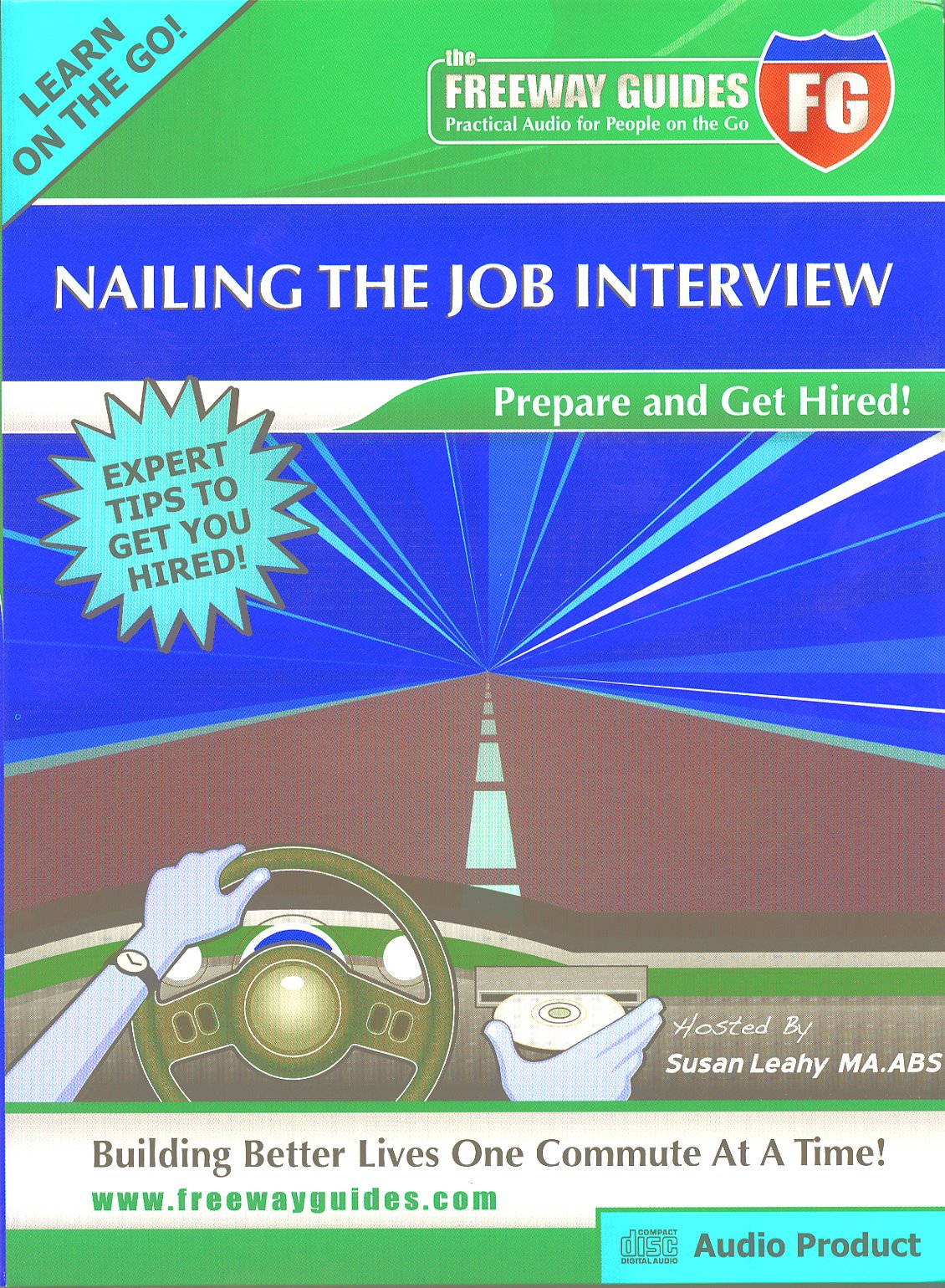
Reviewed: “Nailing the Job Interview,” by Susan Leahy, The Freeway Guides audiobook series, 2008, $18.95, Audio CD, 80 minutes.

If you’re looking to brush up on your interviewing skills, The Freeway Guides audiobook “Nailing the Job Interview” provides some food for thought.
The well-paced CD is voiced by Susan Leahy, a self-described “job interview expert,” who co-founded The Freeway Guides series of audiobooks on topics including public speaking, wedding planning and healthy eating. Developed on the premise that people are spending a lot more time in their car, The Freeway Guides are simple and educational programs for those who want to “learn on the go.”
Consider that lost time you spend in your vehicle each day driving to and from work. For a previous job, I battled daily traffic on Route 422 to the King of Prussia area. During those tedious drives, I could’ve been listening to something educational, such as these guides, had they existed back then.
“Nailing the Job Interview,” is not something I’d recommend listening to as you are driving to your interview, however. The tips would be most helpful several days before a big interview. Leahy’s suggestions include coming up with a “portfolio” prior to the big day. It might include extra copies of your resume, cover letter and reference list as well as any major reports documents you prepared at a former job. Days before the interview, you should think about the “key messages” you wish to get across, she says. Key messages are ideas that you might repeat several times throughout an interview and illustrate with examples, possibly backed up with documents from your portfolio. Picking out and trying on your clothing before the interview is also suggested, as is covering your “toes, shoulders and tummy.”
“It may sound shallow, but clothes do count in an interview,” Leahy says. “A suit is usually safe.”
Practicing your responses to anticipated questions in front of a mirror or with a friend is also advised. If you tend to use filler words such as “um” and “like,” Leahy suggests taping yourself, and learning to take advantage of “the power of the pause.”
On the day of the appointment, make sure you eat something and don’t overdo the caffeine. A growling stomach will not help you put your best foot forward. Likewise, caffeine coupled with adrenaline (we’ve all been there) might not be the impression of yourself you want to leave.
Plan ahead with your transportation as well by leaving 20 minutes ahead of the time you think you need to leave, giving you time for any traffic snafu or failed Mapquest instruction.
“Being late is reason enough not to get hired,” Leahy warns.Here’s another good piece of advice: When you arrive at the interview, be nice to the receptionist. Sounds simple enough, but many people forget that the receptionist’s impression counts, Leahy says.
When you greet the interviewer, be energetic and smile. Offer a firm handshake. “No dead fish,” Leahy says. And no “GI Joe,” either.
The next tip took me by surprise: “Always say ‘yes’,” if your interviewer offers you some water,” Leahy says. Forget about the standard “No thanks, I’m fine” response to that offer.
Why? “It gives you extra time to get acclimated…And later on, if your mouth is dry, you’ve got water,” Leahy says.
During the interview itself, “Focus on the small stuff,” such as your tone and body language, she says, and don’t forget to let your personality shine through.
Follow up after the interview with a written or verbal thank you. If you do get a job offer, don’t be afraid to negotiate — especially women, who tend to be shy about salary conversations, Leahy says.
“You don’t have to take the first offer,” she says.
Amen to that. Now, in the words of Leahy, “Go in there and drive that interview.”

Enter to win a gently used copy of “Nailing the Job Interview” by emailing your mailing address to mkaras@pottsmerc.com