I love that I can borrow from the WSJ and their talented writers. I'm sure there are a lot more outdated ill-chosen titles out there. Got any suggestions?
Change of fortune makes for book-title bloopers
By LOUISE RADNOFSKY
The Wall Street Journal
WASHINGTON — A financial crisis, a historic presidential campaign and a series of political scandals have scrambled how people understand the world in the past few years.
For some authors, that presents a ticklish problem.
"Obviously I would change the title," says David Lereah, the former chief economist of the National Association of Realtors and author of "Why the Real Estate Boom Will Not Bust — And How You Can Profit From It," published in paperback in February 2006. "There are places in the book where I actually say the boom is not healthy. But people don't read the book, and they just look at the title and they criticize it."
Brooke Masters, author of "Spoiling for a Fight: The Rise of Eliot Spitzer," says her book was right at the time it came out — 18 months before the New York governor was brought down by a sex scandal in March of this year. In any case, she adds, "Spoiling for a fight is totally accurate."
This election season will likely bring more casualties. Among "Why the Democrats Will Win in 2008: The Road to an Obama White House"; "A Bound Man: Why We Are Excited About Obama and Why He Can't Win"; and "Comeback: Conservatism That Can Win Again," someone has to be wrong.
Politics, economics and social-science books are a mainstay of adult publishing, an increasingly lucrative market. Nonfiction sales in the U.S. have risen steadily to 311 million books in 2007 from 270 million in 2004, according to Nielsen BookScan.
But with tens of thousands of new titles competing for attention each year, authors have to make some bold claims — and fast. It's possible to turn around a topical book in weeks. What was once written as history is now appearing as prediction.
"It was more timely than a monthly magazine," says Steve Gill, a conservative radio host and author of "The Fred Factor: How Fred Thompson May Change the Face of the '08 Campaign," which was published by Mr. Gill's business partner in May 2007.
The book "blew through" its first print run of 10,000 copies ahead of the former Tennessee senator's declaration in September 2007 that he would run for president, Mr. Gill says. The Thompson campaign lasted barely four months. The book sold about 2,000 of its new run and the remainder were given away or trashed.
"It was truly intended all along to be a work in progress," Mr. Gill says.
Traditional publishing houses say they still want books to feel timeless despite the fast turnaround that new technology allows. "You hope that the book, even if it's about current affairs, will stand as a record of that event," says Carol Schneider, executive director of publicity and public relations for Random House Publishing Group, a division of Bertelsmann AG's Random House Inc.
But she acknowledges that accidents happen. "There's no way to manage it. You're talking about life."
That doesn't sit well with authors, who often blame their publishers when books are overtaken by events. "We argued back and forth," says Mr. Lereah, the real-estate author, who says he didn't want the titles to be so bold. "But you know, I'm a big boy, I agreed to what they told me to do and you've got to live with it," he adds.
Doubleday Business, Mr. Lereah's publisher and a unit of Random House, confirmed that the book's titles were suggested by the publishing team but said that they were based on his reasoning.
"In retrospect, everyone was fooled," says Roger Scholl, editorial director for Doubleday Business. "I would certainly say I was fooled. No one saw what was going to happen with real estate."
Mr. Lereah's book was served up in hardcover in February 2005 with the title "Are You Missing The Real Estate Boom? Why Home Values and Other Real Estate Investments Will Climb Through the End of the Decade — And How to Profit From Them." That edition sold 12,000 copies.
It was downhill from then. The paperback sold 2,300 copies in 2006 and 250 in 2007, according to Nielsen BookScan. So far this year, it's notched just 20 sales, Nielsen says.
Publishers say they're under pressure to craft titles that can quickly launch a book. "There is a trend of subtitles getting longer and longer and publishers insisting that a subtitle needs to explain everything about the book," says Bruce Nichols, vice president and publisher of Collins, a division of News Corp.'s HarperCollins. (News Corp. is the owner of Dow Jones & Co., publisher of The Wall Street Journal.)
Kevin Hassett, co-author of the 1999 book "Dow 36,000: The New Strategy for Profiting From the Coming Rise in the Stock Market," says criticism of his book isn't something he's lost a lot of sleep over. He is now an economics adviser to Republican presidential candidate John McCain. The Dow Jones Industrial Average closed yesterday at 11230.73.
"I think that it's important for public discourse for people to be willing to take clear positions," he says. "You can be negative and be wrong year after year and somehow it doesn't create angry critics, but if you're optimistic and incorrect the response is much more vocal."
And angry readers? They mostly have themselves to blame, says Philip Tetlock, a psychologist and author of "Expert Political Judgment: How Good Is It? How Can We Know?" which details humans' insatiable desire for more certainty than is possible.
"My counsel is greater modesty," Mr. Tetlock says. "People should expect less from experts and experts should promise less."
Showing posts with label business books. Show all posts
Showing posts with label business books. Show all posts
Wednesday, September 10, 2008

Monday, July 7, 2008
Book: Whatever makes you happy should be a line item in your personal budget
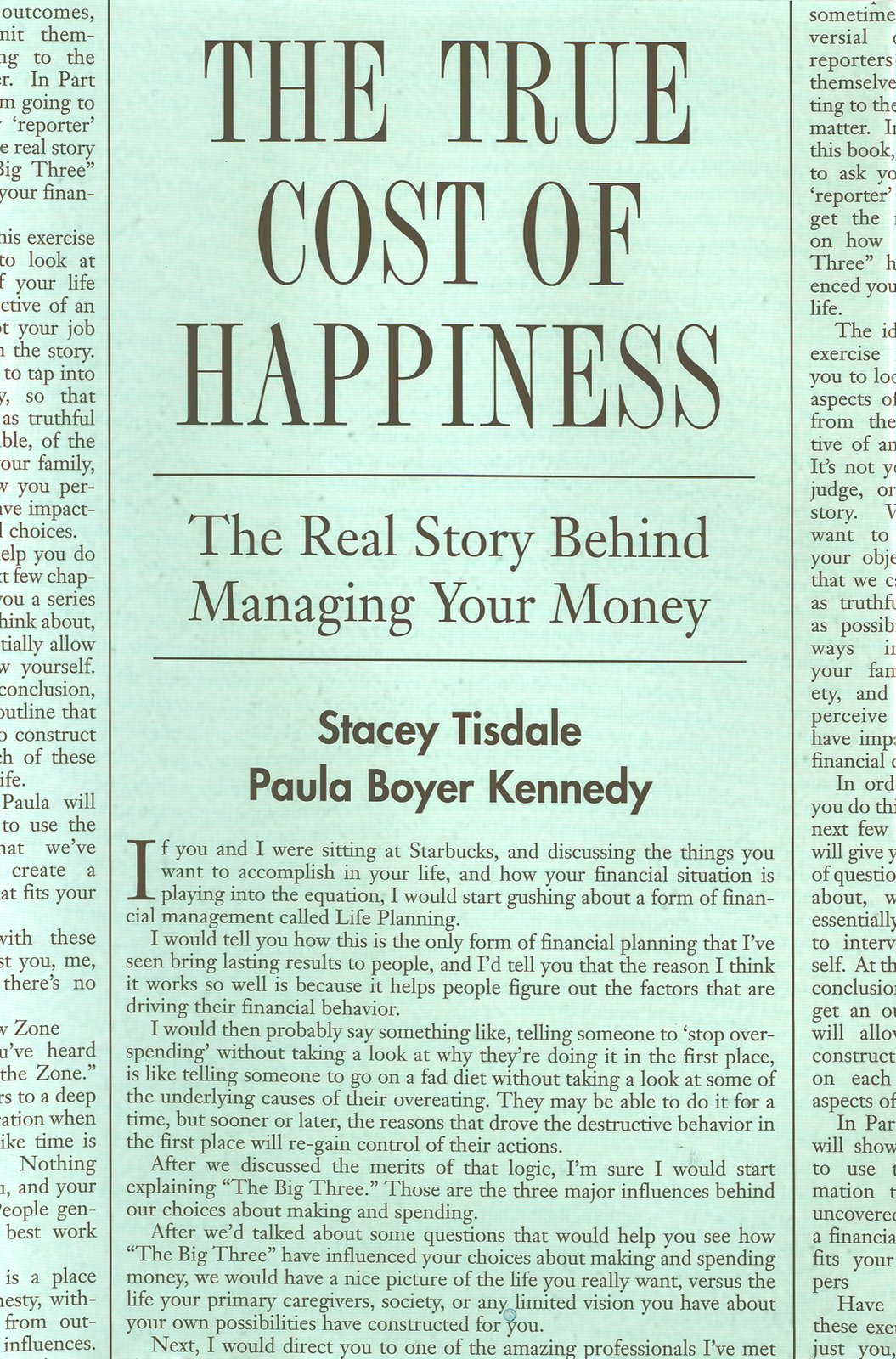
Reviewed: “The True Cost of Happiness,” by Stacey Tisdale and Paula Boyer Kennedy, Wiley, 2007, $24.95, 288 pages.
How your parents handled money influences the way you handle your finances, according to “The True Cost of Happiness,” a book co-authored by business journalist Stacey Tisdale and financial planner Paula Boyer Kennedy.
Readers are encouraged to take a look at the role family dynamics play in their financial behavior.“I’m talking about the ways in which the first lessons we learned about money as children affect our decision about making and spending it as adults,” writes Tisdale, who penned the first half of the book, which focuses on self-awareness.
In my family, my father managed the money. My mom took care of the house and three kids. The bills and the bank account were the man’s job. When my father died at age 58, losing a 13-year battle with cancer, my mother was thrust into a position of total financial responsibility — a role no one had prepared her for. When my mom was growing up, her father took care of the household finances. She learned at an early age that money was the man’s job. And that was the norm of the time, and it worked out OK for my mom. Until circumstances in her adult life necessitated a crash-course in paying bills.
Learned financial behaviors are what Tisdale and Boyer Kennedy call “money scripts.” Leaving room for you to write down your thoughts, they ask you to explore your own “money scripts” learned in childhood, and look at how they play a part in your financial attitudes as an adult.“Think about those money scripts that are limiting you. Imagine your life without those messages. How would your actions be different?” the authors write.
If your behavior isn’t leading you to your financial goals, then you need to take a new tack, they say. They walk you through ways to make those changes. One fun exercise, that I’m sure each of us has indulged in some variation, is:
•Imagine that you have all the money you will ever need. Decide what you would do with it, your life and your time.
•Next, change that picture. Now you only have 5 to 10 years to live. How will you change your life? What will you do with the time you have left?
•Lastly, imagine the changes you’ll wish you had made if you only have 24 hours to live.“The question is not what you would do with the time you have left, but what are your regrets?” the authors ask. That last scenario, they say, “cuts deepest of all. It becomes clear which issues in life are superficial and which are central. Sometimes this exercise delivers a … longing or wish that has never before surfaced.” It’s a thought-provoking way of getting to your big picture goals.
For instance, I have a desire to travel, but I feel like with my current monthly bills (mortgage!) I don’t have enough money to go anywhere. Per the authors’ advice, I can afford a trip to, say, Italy, if I make a budget and start setting aside a small sum every month.
Those who dislike the “getting in touch with your financial feelings” part of the book may be more comfortable with the second half of the book, which focuses on numbers. Basically, it tells you how to make a budget — something a lot of people simply don’t do. “We think having to literally face your values and your barriers each time you look at your finances will be an important factor in keeping your financial decisions aligned with your priorities,“ writes Boyer Kennedy, who handles the numbers-focused latter half of the book.
In other words, make a budget and stick to it and you may be able to save some money for a trip abroad … or retirement!
While the authors offer some very sound, practical advice, they also suggest that readers visit a financial planning professional to help you figure it all out.“The True Cost of Happiness” helps readers to determine why they spend/save as they do and what they could do better to meet certain goals.
Michelle Karas is The Mercury’s business editor.
Friday, June 13, 2008
‘Life lessons’ may not solve the mysteries of the universe, but could give you a chuckle

Reviewed: “Do You Know How to Shut Up? And 51 Other Life Lessons That Will Make You Uncomfortable,” by Michael Staver, Mac Daddy Publishing, 2008, $14.95, 119 pages.
Knowing when to shut up, according to author Michael Staver, is a lost art.
I would have to agree. Especially in my office (no offense, coworkers).
Journalists, you see, not only love to write, they loooooove to share their opinions. Mostly about politics. Ick.
“Have you ever been in a conversation with a person who has already made his point but just won’t let it go?” Staver asks in his book “Do You Know How to Shut Up? And 51 Other Life Lessons That Will Make You Uncomfortable.” (Yes! The answer is yes!)
He continues, “Worse yet are you that person? Some people love the sound of their own voices, while others may simply chatter on out of nervousness or because they are uncomfortable with silence. Regardless, it’s annoying and counterproductive.”
The key, according to Staver, is to simply become more comfortable with speaking less, and more effectively. This will come with practice, he says.
This is less of a tip, than a way to get an eye-catching title for a book of business-related tips (about one every other page).
Marketed as a business/self-help book, “Do You Know How to Shut Up?” is a compilation of short bursts of advice Staver has passed along to his clients over the years. He’s CEO of The Staver Group, a national team of strategic business advisors and coaches.
Other gems Staver shared from lessons learned over the course of his 25-year career include: Can You Be Still? How Clear Are Your Boundaries? What Does It Take to Communicate with the Opposite Sex? Do You Know How to Handle Challenging People? Who Should You Blame? And Do You Stand Out (In a Good Way)?
Come to think of it, these are all kinda funny and perhaps are all good questions for anyone in business.
Consider Staver’s Life Lesson No. 8: Can You Be Still?I’m as guilty as anyone of trying to do too many things at once, and of “not seeing the forest through the trees,” as my mom likes to tell me.
Staver seems to think meditation is the answer.
“The most effective way to get more of what you want, and less of what you don’t want, is to commit to stillness on a regular basis,” he writes. “Stillness does not necessarily involve sitting quietly at the feet of some monk in a mountain hideaway. It is about a mindset and a willingness to approach stillness physically, emotionally, mentally and spiritually.”
To achieve this elusive stillness, Staver offers some homework suggestions including setting aside time to do nothing each week — even penciling it in on your calendar — and turning off all computers and cell phones while you’re at it.
“Be patient,” he advises. “It will take about one month before you really experience results.”
Life Lesson No. 27: Do You Know How to Handle Challenging People? — is a surprising mere three short paragraphs long. The gist is, difficult people aren’t worth your time.
What’s helpful are Staver’s strategies for dealing with said difficult people. These include, “Determine how much mental and emotional energy you are willing to invest in a particular person.”
The trouble is, you’re usually far more invested than you’d like to be when you realize that person’s such a pain.
Well, this book might not be the key to the mysteries of the universe, but it’s a cute little book. Probably better for a laugh than for actually helping you out of challenging office situations. But, then, we could all use a little more laughter. Or stillness.
Wednesday, May 7, 2008
‘Commerce with a cause’ and divine customer service

When your printer runs out of ink, wouldn’t you feel better buying a replacement cartridge from a business that gives part of your purchase price to good works?
That’s the story behind “LaserMonks: The Business Story Nine Hundred Years in the Making,” by Sarah Caniglia and Cindy Griffith.
It’s about a group of Cistercian monks in Wisconsin who run a mail-order ink- and-toner business so their abbey can be self-sustaining. They also believe in going the extra mile when it comes to customer service and donating to charities.
“In the next 10 years, the trend toward purchasing with a purpose will continue to grow. Consumers will demand that the goods and services they purchase come from companies that are actively involved in doing good works in the community,” write the authors.
The monks choose a “charity of the month” each month and announce it on their Web site. They also allow customers to choose additional charities to receive funds.
That quirky little premise was enough for me to give the book a read. That and the fact that they call their employees “MonkHelpers.” Weird, but cute.

The two women developed a customer-service philosophy, along with their monk friends, that follows the Rule of St. Benedict: “kindness, hospitality, and charity above all.”
Treating customers well and continually seeking to improve the customers’ experience kept them coming back.
“We realized that rather than pat ourselves on the back for satisfying 98 percent of our customers, we needed to dig deeper into the two percent who had a less-than-stellar experience,” Caniglia and Griffith write.
The company now surveys customers quarterly to find ways to improve customer service.
“The more we do to care for our customers, the more they care for LaserMonks, which enables us to do more for the community at large,” the authors write.
Since the concept was developed in 2001, the LaserMonks’ business has grown to a $10 million per year venture, all the while keeping charity at the heart of everything they do.
This kind of story — monks in middle America running a successful online business and sharing their marketing secrets — isn’t published every day. Though it was a little dull and longwinded in parts, the core philosophy is unique and interesting.
The next time my printer needs ink, I’ll look to LaserMonks.com. Not just for the competitive prices and mission of charity, but for the knowledge that if I need customer service, I will be taken care of. That’s a rarity in today’s world, and especially in e-commerce.
Enter to win a gently used copy of “LaserMonks” by emailing your mailing address to mkaras@pottsmerc.com
Subscribe to:
Posts (Atom)