Showing posts with label Barbara Kingsolver. Show all posts

Tuesday, August 9, 2011

Kingsolver to receive prestigious award, $10K honorarium

Author Barbara Kingsolver will receive the first-ever Richard C. Holbrooke Distinguished Achievement Award, organizers of the Dayton Literary Peace Prize announced last week.

Below is information sent to me in a press release from Dayton Literary Peace Prize. As a fan of Kingsolver's since "The Bean Trees" and "Pigs in Heaven," I'd have to agree with the judges' choice. To learn more about Kingsolver, pictured above, and her magical books, visit her official site.

The award, formerly known as the Lifetime Achievement Award, was renamed in honor of the late Richard C. Holbrooke, the U.S. diplomat who played an instrumental role in negotiating the historic 1995 Dayton Peace Accords, which ended the war in Bosnia. The award will be presented to Kingsolver by journalist Kati Marton, Holbrooke’s widow, at a gala ceremony in Dayton on November 13. Holbrooke died in December 2010 while he was serving as special advisor on Afghanistan and Pakistan under President Obama. As part of the award, Kingsolver will receive a $10,000 honorarium.

“Richard Holbrooke passionately believed in the power of words to forge peace and understanding, and Barbara Kingsolver’s impressive body of work beautifully reflects that mission,” said former Ohio Governor Bob Taft (1999-2007), chair of the selection committee*. “A writer of elegant and graceful prose, she leaves the reader with a sense of urgency about the topic she cares for most: the complex nature of what it takes to live together peacefully and creatively.”

“I am deeply honored and appreciative of the renaming of this award for my husband,” said Marton. “It is a spectacular way to remind the world of a time when negotiated peace saved uncountable lives. The Dayton Peace Accords were a milestone in Richard’s career and should remain a model for waging peace in these troubled times.”

Since she began her career in the 1980s, Kingsolver’s fiction, nonfiction, essays, and poetry have often explored issues of social justice, biodiversity, and the interaction of human beings with their community and the natural world. She is the author of "The Poisonwood Bible" (1998) (which I blogged about here), a modern classic that chronicles one family's tragic undoing and remarkable reconstruction over the course of three decades in postcolonial Africa, and "The Lacuna" (2009), a gripping novel exploring the intricate relationship between Mexico and the United States. Her nonfiction works include the acclaimed "Small World," a collection of essays written in response to 9/11 which nimbly skips from the Grand Canyon to the civil rights movement to her own vegetable garden to show how everything in this world is connected.

“I'm very moved by both the legacy and the aspirations of this prize,” said Kingsolver. “It will be an honor to stand in the heart of the country and celebrate peace.”

Kingsolver will join the ranks of past winners of the award, including Studs Terkel (2006), Elie Wiesel (2007), Taylor Branch (2008), Nicholas Kristof and Sheryl WuDun (2009), and Geraldine Brooks (2010).

Finalists for the 2011 Dayton Literary Peace Prize for Fiction and Nonfiction will be announced in August.

About the Dayton Literary Peace Prize:
The Dayton Literary Peace Prize honors writers whose work uses the power of literature to foster peace, social justice, and global understanding. Launched in 2006, it has already established itself as one of the world’s most prestigious literary honors, and is the only literary peace prize awarded in the United States. As an offshoot of the Dayton Peace Prize, the Dayton Literary Peace Prize awards a $10,000 cash prize each year to one fiction and one nonfiction author whose work advances peace as a solution to conflict, and leads readers to a better understanding of other cultures, peoples, religions, and political points of view. An annual lifetime achievement award is also bestowed upon a writer whose body of work reflects the Prize's mission.

Tuesday, September 22, 2009

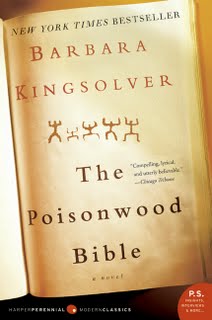
The Poisonwood Bible: A Novel

Barbara Kingsolver's "The Poisonwood Bible: A Novel" (HarperCollins, 1998, 543 pp.) is an epic by definition and in scope and proportion. I realize now I was just cutting my teeth on Kingsolver's earlier, shorter yet just as vividly and potently written novels, "The Bean Trees" and "Pigs in Heaven." I am now convinced of - or happily reacquainted with - her genius.

What begins as the tale of an evangelical Baptist family on a mission trip to the Belgian Congo in the late 1950s, evolves into a larger more allegoric tale.

Nathan and Orleanna Price bring their four daughters, Rachel, twins Leah and Adah, and baby girl Ruth May into the remote jungle village of Kilanga fully unprepared for what awaits them. They bring with them cake mixes, bean seeds and Sunday best clothes, not realizing the climate will render such things useless.

The book's chapters are narrated by the female characters in turn. The viewpoints range from self-centered teen Rachel, who worries more about her appearance than anything else, to crippled Adah, who, due to a birth deformity, walks with a limp and tends to see things differently - literally: She reads books back to front, speaking and reading the words backwards. Leah drinks in Kilanga, becomes a huntress, a teacher, a speaker of its language. Then there's the innocent Ruth May, wide-eyed and accepting, who teaches the village children to play "Mother May I."

I expected the book to end with the family's return to the states. But the majority of the family never go back to their native land. We follow the girls into their very different adulthoods and witness how Africa has marked and changed them forever.
I can tell you that one of the daughters loses her life on that vast continent, as Orleanna will tell you on page one of the novel. But she won't tell you which one. That's revealed a few hundred pages later.

Orleanna (the mother): "We aimed for no more than to have dominion over every creature that moved upon the earth. And so it came to pass that we stepped down there on a place we believed fully unformed, where only darkness moved on the face of the waters. Now you laugh, day and night, while you gnaw at my bones. But what else could we have thought? Only that it began and ended with us. What do we know even now? Ask the children. Look at what they grew up to be. We can only speak of the things we carried with us, and the things we took away."

The poisonwood bible, the basis of the novel, basically says that, well, "Tata Jesus" really is "bangala," a Kikongo word that can have several meanings, including most precious and most deadly. The bible, for a baptist preacher, is a much different set of life lessons when compared to the hundreds of years of oral traditions passed down through the ranks of the African villagers. Baptism, which may be a sacred rite for the Rev. Nathan Price, is equated with fear and certain death for the children of Kilanga (in a river rife with hungry alligators). Simlarly, their ways confounded the Rev. Price.

Ruth May: "Father is trying to teach everybody to love Jesus, but what with one thing and another around here, they don't. Some of them are scared of Jesus, and some aren't, but I don't think they love Him. Even the ones that go to church, they still worship the false-eye dolls and get married to each other time and time again. Father gets right put out about it."

There is also the political aspect of the novel. The Belgians, the Portuguese, the Americans and others who exploited the various African countries' resources (diamonds, people) and tried to force Africa to adapt to their ways might have won the battle, but not the war, Kingsolver seems to say. These conquerers and their pieces of history will dissolve into the greater story of Africa.

My journey through this novel, I can say with chagrin, took roughly a month (kind of an epic in itself). I got the audiobook out of the Pottstown Public Library for a 6-hour roundtrip in August. It was interesting because Kingsolver read the novel herself, and did the various girls' voices, Georgia accents and childish misconceptions and all.

But I didn't get through it all, because the tapes ran 10+ hours, and my check out time ran out. I traded them in for the actual book after my trip. I hauled that huge library book around for a long time! Not that the reading wasn't enjoyable, just that I've been busy and have only been reading a page or two here and there.

This morning, as I finished the novel, I was happy to be reunited with the voice of the Price sister/daughter who didn't make it. How fitting that she should narrate the end of the novel. She was there with the family all along, and urges them to move on with their lives.